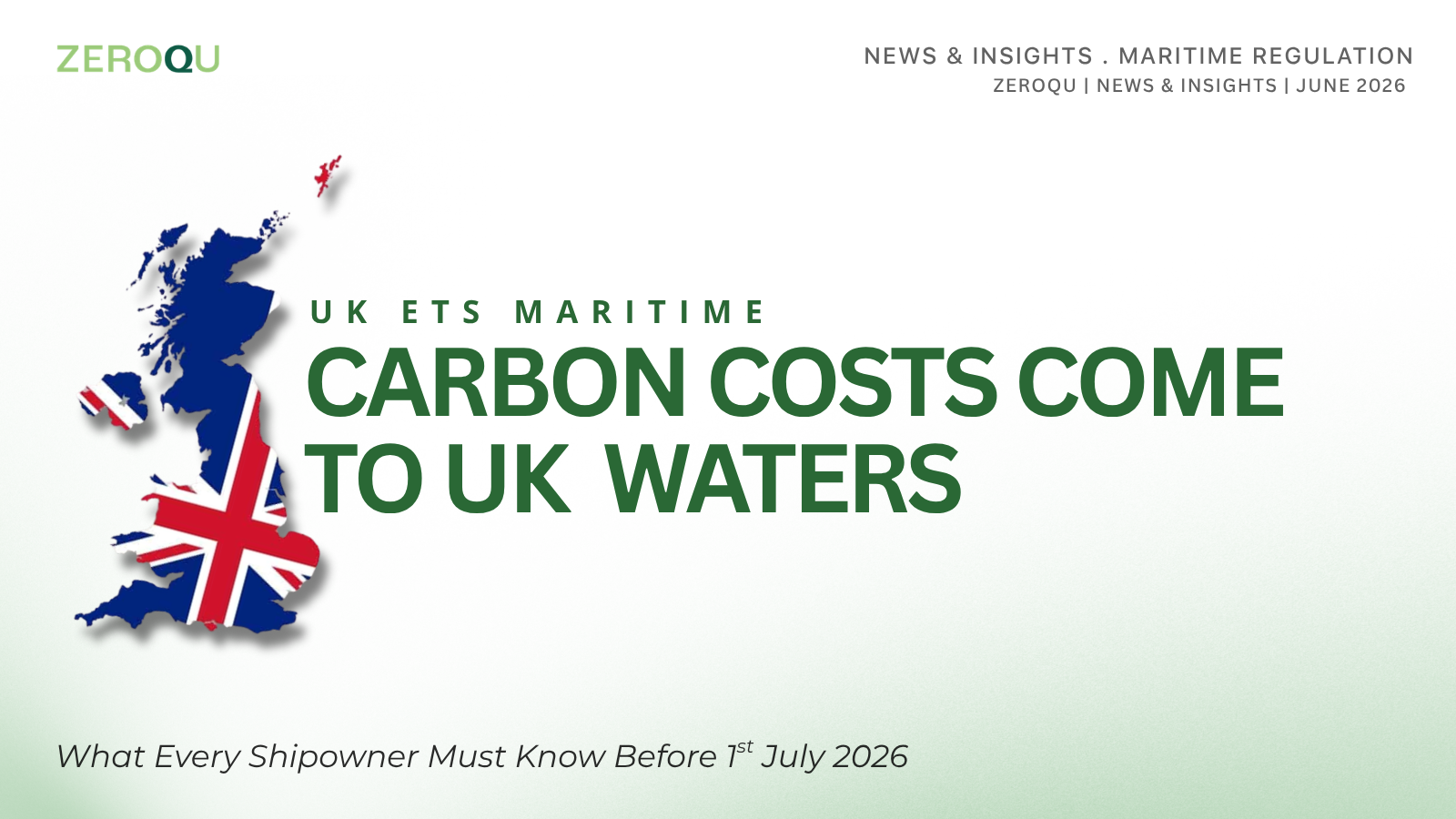
For years, shipping decarbonisation has largely been a conversation about monitoring and reporting. That conversation is now shifting decisively toward something with direct commercial consequence — carbon cost exposure.
From 1 July 2026, the UK Emissions Trading Scheme (UK ETS) formally extends to the maritime sector. The rules are clear, the deadlines are set, and the financial obligations are real. For shipowners, operators, and technical managers trading in UK waters, this is no longer a regulatory horizon, it is already here.
| 5,000 GT+ Vessel size threshold | 100% Emissions surrendered from Day 1 | ~15% UK shipping emissions at launch | £49.41 Civil penalty rate / tCO₂e (2026) |
What Is the UK ETS and Why Does It Matter for Shipping?
The UK ETS is a cap-and-trade carbon pricing mechanism, modelled broadly on the EU ETS framework, designed to put a direct financial cost on greenhouse gas emissions. Operators in covered sectors must purchase UK Allowances (UKAs) and surrender them annually.
Previously, the scheme was applied to aviation, power generation, and heavy industry. The expansion to domestic maritime is a significant structural step that places shipping within the UK’s binding net-zero trajectory.
Carbon price context: the 2026 civil penalty rate has been set at £49.41 per tonne of CO₂e (12-month average UKA settlement price for 2025). Actual market UKA prices were approximately £57/tCO₂e in early 2026 , directly translating emissions into an operating cost line.
Who Is Covered?
The UK ETS maritime framework applies to vessels of 5,000 Gross Tonnage (GT) and above. Covered greenhouse gases include:
- CO₂ — Carbon dioxide from fuel combustion (GWP = 1)
- CH₄ — Methane, including methane slip for LNG vessels (GWP = 28, IPCC AR5)
- N₂O — Nitrous oxide from combustion byproducts (GWP = 265, IPCC AR5)
The scheme covers three operational contexts:
- Domestic voyages — between any two UK ports, including round trips. All emissions at sea, at anchor, and while moored are included.
- Emissions at berth and at anchor — in any UK port, regardless of whether the overall voyage is domestic or international.
- Movements within port — maneuvering and all in-port activity.
Special case — Northern Ireland ⇔ Great Britain voyages:
A 50% surrender obligation applies from launch (1 July 2026), to account for competitive balance on routes shared with the Republic of Ireland.
The Compliance Process: What Operators Need to Do
-
01
Emissions Monitoring Plan
One EMP per company (not per ship), submitted via METS portal. Must list all in-scope vessels. Apply within 42 days of first activity. Early onboarding open now, free of charge via METS portal.
▶ Regulator approves · no verifier involved
-
02
Open MOHA Account
Maritime Operator/Owner Holding Account in UK ETS Registry. Opened automatically by the regulator upon EMP approval — no separate action required.
▶ Auto-opened on EMP approval
-
03
Monitor, Verify & Report
Collect verified emissions per EMP methodology. Submit one Annual Emissions Report (AER) per company by 31 March via METS. Independent verifiers check AER only.
▶ AER due 31 March each year
-
04
Surrender Allowances
1 UKA per tonne of verified CO₂e. Double surrender: 2026 and 2027 allowances both due 30 April 2028. Annual cycle from 2029.
▶ First surrender: 30 April 2028
EMP — Key Facts
- Company-level: One EMP covers all vessels. Ship-level data is reported inside the Annual Emissions Report.
- UK MRV formally revoked: The UK MRV regime has been repealed
- Early onboarding: The Environment Agency supports early EMP approval before 1 July.
Contact: etmaritimehelp@environment-agency.gov.uk
The Compliance Calendar
| Date | Milestone |
|---|---|
| 1 July 2026 | UK ETS Maritime enters into force. First scheme year begins (Jul–Dec 2026). EMP must be active. |
| ~11 August 2026 | EMP application deadline — 42 days after first maritime activity for operators starting 1 July. |
| January 2027 | Offshore vessels confirmed for inclusion in UK ETS, aligned with EU ETS offshore expansion. |
| 31 March 2027 | First verified Annual Emissions Report (AER) due via METS (Jul–Dec 2026). |
| 31 March 2028 | Second AER due, covering full calendar year 2027. GT threshold review also due by end 2028. |
| 30 April 2028 ★ DOUBLE SURRENDER | 2026 and 2027 allowances due simultaneously — 1 UKA per tonne CO₂e for both years, settled in one date. |
| 2028 (proposed) | International voyage legs potentially added at 50%. The decision is subjected to Authority response to closed consultation. |
Who Is Responsible?
By default, the registered owner holds compliance responsibility. This may be formally delegated in writing to the ISM Company (typically the technical manager). The delegation agreement must be in place before 1 July 2026.
| Jurisdiction | Regulator |
|---|---|
| England (+ all non-UK operators) | Environment Agency (EA) |
| Scotland | SEPA |
| Wales | Natural Resources Wales (NRW) |
| Northern Ireland | DAERA |
| Offshore oil & gas operators | OPRED (part of DESNZ) |
How UK ETS Differs from EU ETS
| Dimension | EU ETS | UK ETS |
|---|---|---|
| International voyages | 50% (to/from EU ports) | Not covered at launch; proposed 2028 |
| Domestic voyages | 100% | 100% |
| In-port emissions | 100% | 100% |
| Surrender phase-in | 40% (2024) → 70% (2025) → 100% (2026) | 100% from day one |
| Allowance Surrender | 30 September each year | 30 April 2028 (double for 2026+2027) |
| Account setup | Operator manages via registry | Auto-opened on EMP approval |
| Gases covered | CO₂ only 2024–25; + CH₄, N₂O from 2026 | CO₂, CH₄, N₂O all from launch |
| Offshore vessels | Being integrated | Confirmed from January 2027 |
What Comes Next: The 2028 Expansion
The UK ETS Authority has been consulting on extending the framework to cover 50% of emissions from international voyages to and from UK ports which mirrors the EU ETS approach. The target year for this expansion is 2028. The consultation was closed on 20 January 2026, and Authority response is awaited.
- 50% of emissions from UK-international voyage legs (aligned with EU ETS)
- Continued exclusion of Crown Dependencies and British Overseas Territories (subject to review)
- Review of the 5,000 GT threshold by end of 2028
- Offshore ship integration aligned with EU ETS offshore expansion
Emerging Mechanism: Emissions Reduction Claims (ERCs)
One innovative feature unique to the UK ETS framework is the introduction of Emissions Reduction Claims (ERCs). Under specific conditions, operators using eligible zero-emission or low-emission fuels may apply zero-emission factors for qualifying fuel consumption, reducing their surrender obligation.Further guidance is expected from the Authority ahead of launch.
The Questions the Industry Is Still Asking
- International voyage expansion (2028): Will the consultation confirm 50% coverage from 2028? Broad stakeholder support was expressed. Still Authority response is awaited.
- EU–UK ETS linkage: In 2025, the EC and UK Government announced negotiations to link the two carbon markets, which could reshape allowance prices and dual-compliance frameworks.
- Allowance cost pass-through: How UKA costs will be allocated between registered owners and charterers remains commercially complex, particularly for spot market charters.
- UK FuelEU equivalent: Whether the UK will develop its own well-to-wake fuel intensity regulation (analogous to FuelEU Maritime) remains an open policy question.
The Bigger Picture
The direction of travel across the maritime sector is clear and accelerating. IMO’s net-zero framework, EU ETS and FuelEU Maritime in Europe, and now UK ETS domestically. Emissions are being progressively repriced from a reporting exercise into a direct commercial variable linked to every voyage, every fuel choice, and every port call.
The 2026 scope currently covers only around 15% of total UK-related shipping emissions. The trajectory toward 2028 and beyond will extend that coverage significantly. For operators, the priority is no longer simply whether to comply, but how well they can do so. The only way ahead is with accurate data, optimised fuel strategy and operational processes that translate regulatory cost into competitive advantage.
At Zeroqu, we believe that robust emissions data, maritime intelligence and smart compliance tooling are the foundation on which that competitive advantage is built.
For more information on how Zeroqu supports UK ETS readiness — including EMP preparation, emissions monitoring, and fleet-level carbon cost analysis — contact our maritime team.
hello@zeroqu.com
.png)


.png)