.png)

.png)




From Data to Compliance: The Critical Role of Monitoring Plans in Maritime Regulations

The Foundation of Maritime Emissions Compliance
As maritime decarbonization regulations continue to expand, compliance is no longer limited to annual emissions reporting. Under the EU Monitoring, Reporting and Verification (MRV), EU Emissions Trading System (EU ETS) and FuelEU, shipping companies must establish a robust framework for collecting, managing and validating emissions data.
At the heart of this framework lies the Monitoring Plan.
What happens when your emissions data is wrong and regulators come knocking?
The maritime industry entered a new compliance era when shipping was incorporated into the EU ETS from January 2024. In addition to reporting emissions, shipping companies must now surrender EU Allowances (EUAs) equal to their verified emissions, with financial penalties for any shortfall. The surrender obligation was phased in — 40% of 2024 emissions, 70% of 2025 emissions, and 100% from 2026 emissions onward — so full-cost exposure applies from the 2026 reporting year.
The regulatory scope has also expanded significantly:
| Requirement | Details |
|---|---|
| Gases covered | CO₂, CH₄ (Methane), N₂O (Nitrous Oxide) under MRV reporting; CH₄ and N₂O are priced under the EU ETS only from 2026. |
| Vessel threshold | 5,000 GT and above subject to MRV (general cargo and offshore ships of 400–5,000 GT report from 2025; offshore ships ≥5,000 GT enter the ETS from 2027). |
| FuelEU Maritime | GHG intensity limit on the energy used on board (well-to-wake), tightening from −2% (2025) toward −80% by 2050 |
What is a Monitoring Plan and Why Does It Matter So Much?
A Monitoring Plan is the official document that describes how a shipping company monitors and reports greenhouse gas emissions for each vessel under its responsibility.
A complete Monitoring Plan defines:
- Fuel consumption monitoring — methodologies covering (Methods A, B, C & D) (A = BDN + tank stocktake; B = on-board bunker tank monitoring; C = flow meters; D = direct CO₂ emission measurement)
- Emission calculation framework — calculation procedures and conversion factors for emission reporting
- Data collection management — data collection workflows across the fleet data
- Data gap handling — procedures for handling data gaps
- Risk management procedures — procedures for identifying and mitigating reporting risks
The Link Between Monitoring Plans and EU ETS Costs
Under the EU ETS, every reported tonne of emissions can translate directly into compliance costs. The ETS applies to 100% of emissions on voyages and port calls within the EU/EEA and 50% of emissions on voyages into or out of the EEA, so a vessel's chargeable share depends on its trade pattern.
For example:
| Vessel scenario | Annual CO₂ (tonnes) | EUA price (illustrative) | Compliance cost |
|---|---|---|---|
| Small cargo vessel | 20,000 | €75 | €1.5 million |
| Mid-size vessel | 50,000 | €75 | €3.75 million |
| Large container ship | 120,000 | €75 | €9 million |
| 1% monitoring error on mid-size vessel | — | — | €37,500 |
Figures are illustrative: they assume a fixed €75 EUA and 100% surrender (full phase-in from 2026). Actual cost varies with the EUA market price (roughly €65–90 in 2024–25) and the in-scope share of each voyage (50% or 100%).
Even a 1% inaccuracy in emissions data on a mid-size vessel translates to €37,500 in potential misreported allowances before any regulatory penalty is applied.
Principles Every Monitoring Plan Must Embody
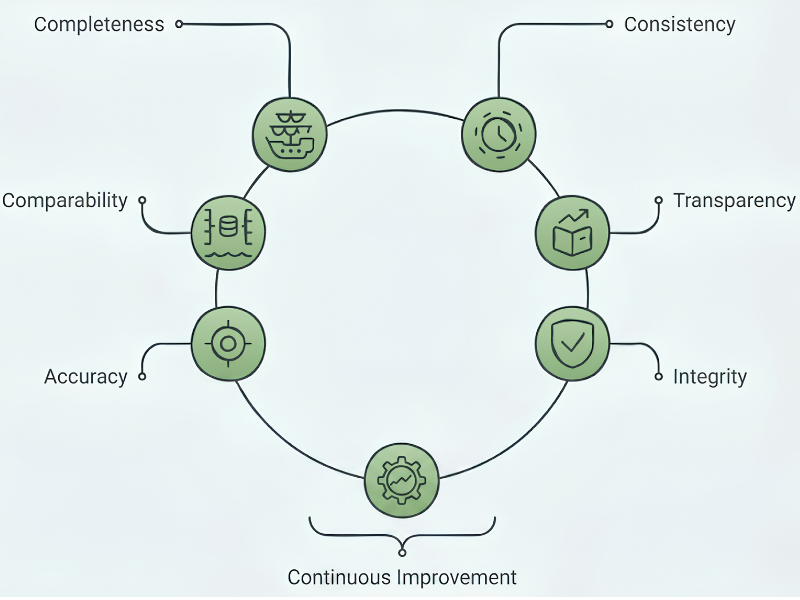
The Regulation sets seven principles that every Monitoring Plan must reflect:
| Principle | What it requires |
|---|---|
| Completeness | Every emission source onboard — from main engines to waste incinerators — must be covered with no exceptions. |
| Consistency | Monitoring methodologies cannot be changed arbitrarily across reporting years. |
| Comparability | Data must be comparable across vessels and reporting periods through consistent methodologies and units. |
| Transparency | The entire data flow must be documented and accessible to verifiers and authorities at any time. |
| Accuracy | Data must be neither systematically nor knowingly inaccurate; measurement uncertainty must be minimised. |
| Integrity | Methodology must withstand intensive third-party testing and produce unbiased results. |
| Continuous Improvement | Companies must proactively review and strengthen their monitoring approach each compliance cycle. |
How Zeroqu Simplifies Monitoring Plan Compliance
At Zeroqu, we understand that compliance is not just about meeting regulations — it's about creating efficient and reliable processes.
Our maritime compliance platform helps shipping companies in:
| Capability | What Zeroqu does |
|---|---|
| Monitoring Plan Management | Create, structure, update and maintain Monitoring Plans in line with MRV and EU ETS requirements as regulations evolve. |
| Automated Data Collection & Fuel Data Management | Integrate vessel operational data directly and support fuel monitoring methods A, B, C and D, reducing manual entry and transcription errors. |
| Fleet-Level Emissions Tracking & Reporting | Track and analyse CO₂, CH₄ and N₂O emissions on a per-voyage, vessel, fleet and company basis, generating compliant MRV and EU ETS reports. |
| EU ETS Allowance Compliance Management | Track EU ETS and UK ETS allowance obligations, compliance costs and surrender requirements. |
| Gap Identification & Data Quality Control | Detect data gaps and compliance issues early, preventing verification failures and reporting delays. |
| Compliance Risk Reduction & Transparency | Identify errors early, improve audit readiness and increase transparency across fleets. |
| End-to-End Compliance Coverage | Manage the complete compliance lifecycle from Monitoring Plan creation through emissions reporting and allowance surrender. |
| Regulatory Adaptability | Maintain compliance as reporting requirements and regulations evolve, ensuring continuous readiness. |
Zeroqu helps shipping companies achieve complete, end-to-end compliance coverage by supporting all four approved fuel monitoring methods (A, B, C and D) and tracking key greenhouse gas emissions (CO₂, CH₄ and N₂O).
By digitizing compliance workflows, Zeroqu enables shipping companies to stay ahead of the curve on compliance strategy.
As reporting requirements continue to evolve, the Monitoring Plan becomes the backbone connecting operational data, emissions calculations and regulatory compliance. The compliance cycle runs every year. The Monitoring Plan runs beneath all of it.
Preparing for Future Maritime Regulations
The Monitoring Plan is no longer relevant only for MRV.
It also supports compliance across emerging regulations including:
| Regulation | Monitoring Plan role |
|---|---|
| EU MRV | Primary compliance framework for annual emissions reporting. |
| EU ETS | Verified data feeds directly into allowance surrender obligations. |
| FuelEU Maritime | GHG intensity monitoring requires the same activity data, though FuelEU is measured well-to-wake (lifecycle) while MRV/ETS account emissions tank-to-wake. |
| Future GHG frameworks | Provides the data foundation for future IMO and GHG regulations. |
Companies that invest in strong monitoring systems today will be significantly better positioned for future regulatory developments.
Sources & References
European Commission Directorate-General for Climate Action — The EU ETS and MRV Maritime: General Guidance for Shipping Companies (Nov 2025) · Regulation (EU) 2015/757 (MRV Maritime Regulation) · Directive 2003/87/EC (EU ETS Directive) · Regulation (EU) 2023/1805 (FuelEU Maritime) · European Maritime Safety Agency (EMSA) THETIS-MRV Documentation · European Sustainable Shipping Forum (ESSF) Maritime Guidance · European Commission Climate Action — Reducing Emissions from the Shipping Sector.
Disclaimer
Information in this article is for educational purposes only and not legal or compliance advice. Maritime regulations including EU MRV, EU ETS, and FuelEU are subject to ongoing updates and interpretation. Shipping companies should consult their regulatory advisors and official European Commission guidance for current compliance requirements and implementation specifics.
